Frequency = 1 / period
Period = 1 / frequency
Frequency in Hz (hertz)
Period in s (seconds)
Showing posts with label Waves. Show all posts
Showing posts with label Waves. Show all posts
Saturday, September 17, 2016

3.5 Know and use the relationship between the speed, frequency and wavelength of a wave:
Speed = frequency x wavelength
V = f x λ
Speed in m/s
Frequency in Hz
Wavelength in m
V = f x λ
Speed in m/s
Frequency in Hz
Wavelength in m
3.4 Understand that waves transfer energy and information without transferring matter
As it says, waves transfer energy and information, but not matter.
For example, when your radio picks up radio waves, it doesn't gain mass or anything because matter is not transferred. However, information is (in this case, the voice/music). Another example would be infrared. Here, the heat is transferred, which is a form of energy.
For example, when your radio picks up radio waves, it doesn't gain mass or anything because matter is not transferred. However, information is (in this case, the voice/music). Another example would be infrared. Here, the heat is transferred, which is a form of energy.
3.3 Define amplitude, frequency, wavelength and period of a wave
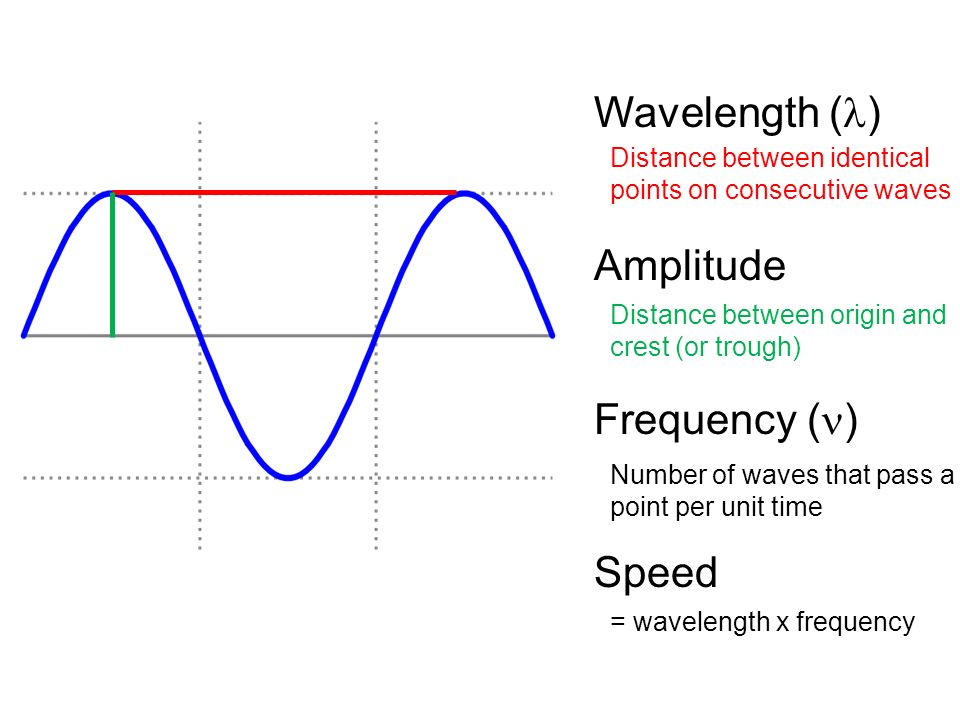 Amplitude (meters)
The distance between the top of a crest (or lowest point of trough) and the point of equilibrium (below it says 'origin' - it means the same thing.)
Wavelength (meters)
The distance between the top of one crest to the next (consecutive wave).
Frequency
Number of waves in one second (not necessarily complete waves)
Period
Time needed to complete one full oscillation
Click here to try a virtual oscilloscope: http://www.educationscotland.gov.uk/resources/s/sound/oscilloscope.asp
3.2 Understand the difference between longitudinal and transverse waves and describe experiments to show longitudinal and transverse waves in, for example, ropes, springs and water
Longitudinal
A longitudinal wave is one whose energy propagation is parallel to oscillation (vibration). Examples include a sound and p waves (seismic waves that travel relatively fast).
A longitudinal wave transfers energy in a way that involves compression and rarefaction. One can use a slinky to demonstrate that by applying a force on one end which will be transferred through the slinky (as can be seen below)
The areas where the 'loops' are bunched up is compression, the parts where they are separated is called rarefaction.

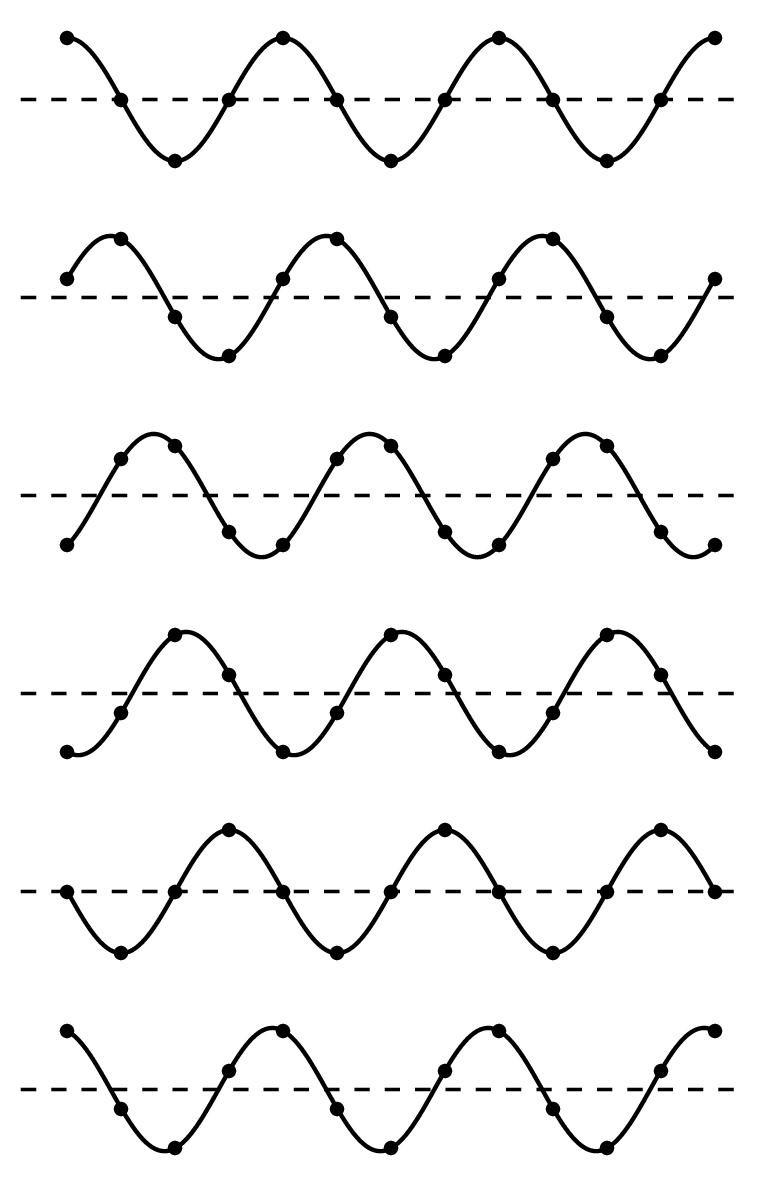
A longitudinal wave is one whose energy propagation is parallel to oscillation (vibration). Examples include a sound and p waves (seismic waves that travel relatively fast).
A longitudinal wave transfers energy in a way that involves compression and rarefaction. One can use a slinky to demonstrate that by applying a force on one end which will be transferred through the slinky (as can be seen below)
The areas where the 'loops' are bunched up is compression, the parts where they are separated is called rarefaction.
Transverse
A transverse wave is one whose energy propagation is at 90° from the direction of oscillation (vibration) - it is perpendicular.
Most waves are transverse - all the waves in the electromagnetic spectrum are, and travel at the same speed in a vacuum. Water and S waves (another type of seismic wave) are types of transverse waves.
One can easily measure the amplitude and wavelength of a transverse wave. Just remember that amplitude is measured from the point of equilibrium (dotted line in the diagram below)
You can move a rope attached to a thin tree (or something like that) and move the rope up and down, and you'll notice that the tree moves. The faster you move the rope, the faster it moves.
See http://www.bbc.co.uk/schools/gcsebitesize/science/aqa/waves/generalwavesrev2.shtml
Friday, September 16, 2016
3.1 Use the following units: degree (°), hertz (Hz), metre (m), metre/second (m/s), second (s).
unit use
° - degree temperature
Hz - hertz frequency
m - meter amplitude; wavelength; distance
m/s - meter per second speed / velocity
s - second time
Important: speed and velocity have the same units, and typically even the same equations. However, velocity is a vector quantity while speed is a scalar quantity
° - degree temperature
Hz - hertz frequency
m - meter amplitude; wavelength; distance
m/s - meter per second speed / velocity
s - second time
Important: speed and velocity have the same units, and typically even the same equations. However, velocity is a vector quantity while speed is a scalar quantity
Subscribe to:
Comments (Atom)