Showing posts with label Forces. Show all posts

Sunday, November 15, 2015

Questions 2 - Vector and scalar quantities

In this question, the following are scalar:

  • density
  • speed
  • time
and these are vectors:
  • weight
  • power
  • energy
  • displacement
  • acceleration
(correct me if I'm wrong)

Friday, October 30, 2015

1.16 Know and use the relationship between weight, mass and gravity

Weight = Mass x Gravity

YOUR WEIGHT IS NOT THE SAME AS YOUR MASS!

Your mass never changes - if your mass is 50 kg, you will still have a mass of 50 kg on the moon, on mars, anywhere. Your weight does change, because it is the effect of gravity on your body - this changes from planet to planet. And in space, of course, your weight = almost 0

W = M x G

Weight is a force, so it's measured in newtons. 
Mass ~ Kg
Gravity ~ 10 on Earth (units are mostly irrelevant, but if you really want to know, it's N/kg)

Fun fact, by Annabel:
The reason the unit for gravity is N/kg is because if you rearrange this equation so that gravity is the subject is becomes:
gravity = weight ÷ mass
which, in terms of units is gravity = N/kg

Thursday, October 29, 2015

1.15 Know and use the relationship between unbalanced force, mass and acceleration:

Force = mass x acceleration

F = M x A

Mass - Kg
Force - N
Acceleration - m/s2

1.13 Find the resultant force of forces that act along a line

If an object has unbalanced forces in multiple directions, there will be a resultant force. This can calculated by subtracting forces in opposite directions. 

Eg. In figure 1 (a), the resultant force will be 2N backwards because 6 - 4 = 2 :)
Figure 1

Wednesday, October 28, 2015

1.12 Understand that force is a vector quantity

This basically means that force always has a direction. When you drive a car, the thrust is forward, air resistance is backwards, etc. 

1.11 Distinguish between vector and scalar quantities

Vector
Has a magnitude and direction.
Examples:

  • Velocity
  • Displacement (net distance travelled from starting point but it's NOT the same as total distance travelled)
  • Acceleration
  • Force (force always has a direction)
  • Momentum


Scalar

Has a magnitude but no direction. 
Examples:

  • Speed
  • Distance


Figure 1

1.10 Identify different types of force such as gravitational or electrostatic

There are lots of different types of forces. These include:

  • Electrostatic
  • Gravitational force; weight which is NOT THE SAME AS GRAVITY 
  • Thrust
  • Upthrust
  • Drag; air resistance
  • Etc. (Just to make it clear, "etc." is not a force :P it means there are other ones that aren't listed here)
GRAVITY. IS. NOT. A. FORCE.

1.9 Describe the effects of forces between bodies such as changes in speed, shape or direction

Forces can change the speed, shape or direction of an object or a series of objects. 

Shape
If you have a perfect square of clay that you spent the last 30 minutes working on (and is still wet, so you can mould it, of course) and your teacher sticks his finger through it, it will get squashed. The teacher has applied a force that has changed the shape of the object.

Speed
If an object is moving at a steady speed, the forces pulling it forward/backwards are balanced. If it accelerates, the force driving it forward is greater than the one pulling it back. If it decelerates, it's the other way around; the force pulling it back is greater than the force driving it forward

Direction
The object will move in the direction of the greatest force that is acting on the object. I.e. if there is a 5N force pulling to the right and a 2N force pulling to the left, the object will move to the right: It will move in the direction of the resultant force


1.8 Determine the distance travelled from the area between a velocity-time graph and the time axis

Distance travelled = Area under the graph

Eg. in figure 1, you'd calculate the area of triangles A and C, as well as the area of rectangle B. So:
A = 0.5 x B x H
= 0.5 x 10 x 20
= 100m
B = B x H
= 20 x 20
= 400m
C = 0.5 x B x H
= 0.5 x 40 x 20
= 400m

Add everything ~400 + 400 + 100 = 900m
Figure 1


1.7 Determine acceleration from the gradient of a velocity-time graph

Acceleration = gradient of graph


Gradient = Rise ÷ Run
[Change in y (rise) ÷ change in x (run)]

In figure 1, the rise would be the dotted line and the run would be how far it is, i.e. from 2 to 6 on the graph below. Let's say that each dash on the y axis represents 1 (i.e. the scale goes 1, 2, 3, 4 etc)

So, if you were to calculate the acceleration:
G = rise ÷ run
= 4 ÷ 5
= 0.8 m/s^2
Figure 1

1.6 Plot and interpret velocity-time graphs

Figure 1: Distance time graph example
Plotting
  • Velocity on y axis
  • Time on x axis
Interpreting
  • Diagonal line going upwards = acceleration
  • Diagonal line going downwards = deceleration
  • Horizontal straight line = constant speed (but not necessarily terminal velocity)
  • The steeper the line, the more acceleration/deceleration


1.4 Describe experiments to investigate the motion of everyday objects such as toy cars or tennis balls

You could do the following experiment:

  • Take a toy wind-up car and put it next to a ruler that is a meter long
  • Wind up the toy car x amount of times
  • Every 5 seconds, record distance travelled by car
  • Plot a graph (distance time graph)

1.5 know and use the relationship between acceleration, velocity and time

Acceleration = (Final velocity - Initial velocity) ÷ time

Acc. = (v - u) ÷ time

Velocity - m/s
Time - seconds
Acceleration -  m/s2

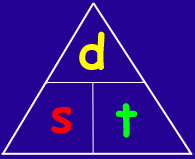
1.3 Know and use the relationship between average speed, distance moved and time

Average speed = Distance moved ÷ Time

S = D ÷ T

Velocity = Distance moved ÷ Time

V = D ÷ T

Velocity/speed - m/s
Distance - m
Time - seconds


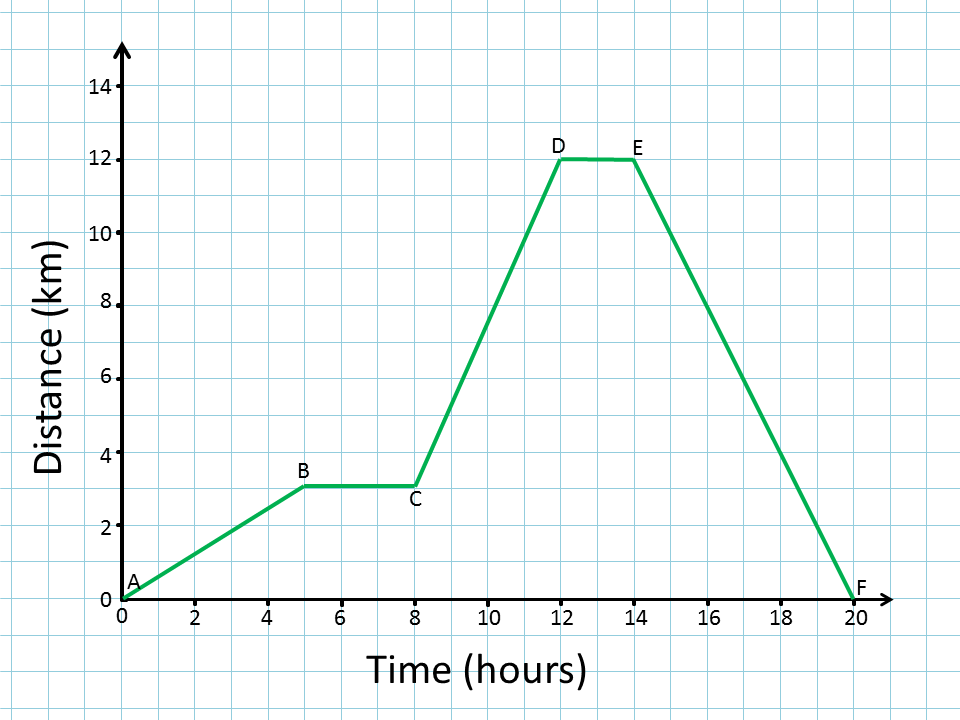
1.2 Plot and interpret distance-time graphs

Plotting
  • Distance must be on the y axis
  • Time must be on the x axis
Interpreting
  • Straight horizontal line (--) means the object is stationary
  • Diagonal line upwards ( / ) means the object is moving forwards. The steeper the line, the faster it is moving.
  • Diagonal line downwards ( \ ) means the object is moving backwards. Again, the steeper the line, the faster it is moving.
  • Although this will most likely not appear in GCSE questions, a curve upwards also means there is an acceleration, a downwards curve means a deceleration

1.1 Use the following units: kilogram (kg), metre (m), metre/second (m/s), metre/second2 (m/s2), newton (N), second (s), newton per kilogram (N/kg), kilogram metre/second (kg m/s)

Measurement                      Symbol               What it measures
Kilogram                                  Kg                           Mass
Meter                                        m                       Distance
Meter per second                    m/s                   Velocity/speed
Meter per second squared      m/s^2                 Acceleration
Newton                                         N                           Force
Kilogram meter per second     kg m/s                Momentum
Newton per kilogram               N/kg                     Moment

Saturday, October 24, 2015

4.1 Use the following units: kilogram (kg), joule (J), metre (m), metre/second (m/s), metre/second2 (m/s2), newton (N), second (s), watt (W).


1.31 Describe elastic behaviour as the ability of a material to recover its original shape after the forces causing deformation have been removed.

Elastic behavior is the ability of a material that can return to its normal shape after forces that caused deformation have been removed.

Eg when an (initially elastic) object no longer does this, it has reached elastic limit.


Figure 1: A spring, for example, shows elastic behavior.

Figure 2: A spring that has been stretched past its elastic limit. This will not return to its original shape :(

1.21 Use the idea of momentum to explain safety features

We already know that force felt = change in momentum ÷ time

To decrease the force felt, you would have to increase the amount of time it takes for the force to be felt. In a car, there are various safety features equipped to do this, as they increase the time that the car's momentum takes to reach zero.

Eg crumple zones in cars slow down the time taken for the momentum to be transferred to the passenger

Some safety features include:
seat belts
air bags
crumple zones
All the above reduce injuries deforming and therefore increasing the amount of time it takes for a person to come to a stop, reducing the acceleration and force on the person, so reducing injury :)
Image: drawing of two safety features of the car. (by: me!!) 
(Yeah okay it's not amazing but it gets the message across)

1.20 Know and use the relationship between momentum, mass and velocity

Momentum = Mass x Velocity

P = M x V

P is measured in kg m/s
M is measured in kg
V is measured in m/s