Showing posts with label Electromagnetism. Show all posts

Sunday, May 29, 2016

6.17 Describe the structure of a transformer, and understand that a transformer changes the size of an alternating voltage by having different numbers of turns on the input and output sides

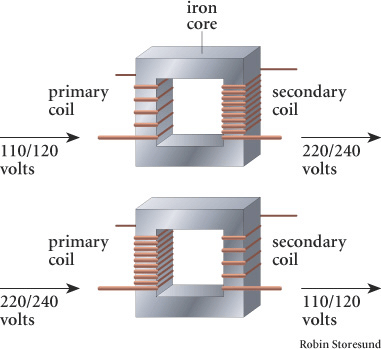
Figure 1

The structure of a step up (above) transformer and a step down (below) transformer can be seen in figure 1. As the voltage decreases, current increases, and vice versa. The transformer changes the size of the voltage by having a different number of primary and secondary coils. If there are more secondary coils, it is a step up transformer and will increase the voltage. If there are more primary coils, it is a step down transformer and will decrease the voltage. (Also has an iron core. That's important.)

6.16 Describe the generation of electricity by the rotation of a magnet within a coil of wire and of a coil of wire within a magnetic field and describe the factors which affect the size of the induced voltage

Most helpful video I've seen in a really long time, which hopefully works....

  • Movement of magnet produces electromagnetic force 
  • Movement + magnetism = current
  • 2 slip rings make contact with 2 brushes with copper or carbon connected to an external circuit
  • Coil rotates, one half upwards, other downwards
  • This produces current in 1 direction
  • As continues rotating, half moving upwards moves downwards, vice versa. This constant change results in AC
  • Replacing slip rings with split ring produces DC because it reverses current when it is naturally going to reverse so it produces current in only one direction
More diagrams here


6.15 Understand that a voltage is induced in a conductor or a coil when it moves through a magnetic field or when a magnetic field changes through it and describe the factors which affect the size of the induced voltage

Voltage is induced in a conductor (typically a wire) or coil when it moves through a magnetic field (i.e when a wire is moved back and forth in a magnetic field) or when a magnet is moved continuously in and out of a coil of wire. 

GOLDEN RULE:
Field + Motion = Current induced

If you:

  • increase magnetic field strength
  • increase speed of magnet going in/out of coil of wire
  • increase number of coils of wire
then more current will be induced :)

Let's talk about the magnet and the coil for a second. How does it work? 
  • Magnet moves into the coil (let's say S side first)
  • Electrons don't like change, so they form a S pole to repel the south pole
  • Magnet moves out
  • But then the electrons miss the south and they want it back (they don't like change) so they create a N pole to attract the south pole back again
  • Magnet moves in
  • This is repeated, inducing an alternating current (AC)
  • (this is the basic idea for a generator)
WARNING: DO NOT USE THE WORD "CREATE" WHEN REFERRING TO CURRENT OR VOLTAGE. YOU WILL GET MARKED DOWN / MARK WILL NOT BE GIVEN.

6.14 Describe how the force on a current-carrying conductor in a magnetic field increases with the strength of the field and with the current.

Two things that increase force on the wire (which is the "current carrying conductor") are:

  • increasing strength of magnetic field
  • increasing amount of current flowing
:)

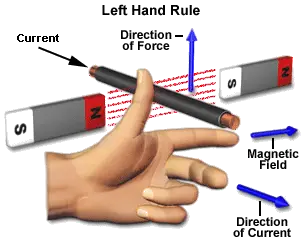
6.13 Use the left hand rule to predict the direction of the resulting force when a wire carries a current perpendicular to a magnetic field

Hello world. This is the left hand rule, and it can be used to determine the direction of force, magnetic field and / or current when a wire carries a current perpendicular  to the magnetic field. (figure 1)

Figure 1

6.12 Understand that a force is exerted on a current-carrying wire in a magnetic field, and how this effect is applied in simple d.c. electric motors and loudspeakers

A force is exerted on a current carrying wire - you see this if you put it between two ends of a U shaped magnet with a current through it. Depending on the direction of the current, it will either move up or down. 

In speakers (link to BBC bitesize), the current is constantly changing direction. This means the poles of the electromagnet change, and so the wire varies between moving up and down - the current varies with the music. The electromagnet moves back and forth, creating vibrations, generating sound waves whose frequency changes with the frequency of the current.

In simple DC motors (link to BBC bitesize) , as we know, the wire experiences a force when it is within a magnetic field, and it moves. The current needs to be reversed every half term, which is done by a split ring commutator, to keep it spinning. The momentum it gains after it has started spinning helps keep it going, too.


6.11 Understand that there is a force on a charged particle when it moves in a magnetic field as long as its motion is not parallel to the field

There is a force acting on the charged particle when it moves in the magnetic field unless its motion is parallel to it, in which case there isn't really, because it is already moving in the direction the magnetic field "wants" it to.

6.10 Sketch and recognise magnetic field patterns for a straight wire, a flat circular coil and a solenoid when each is carrying a current

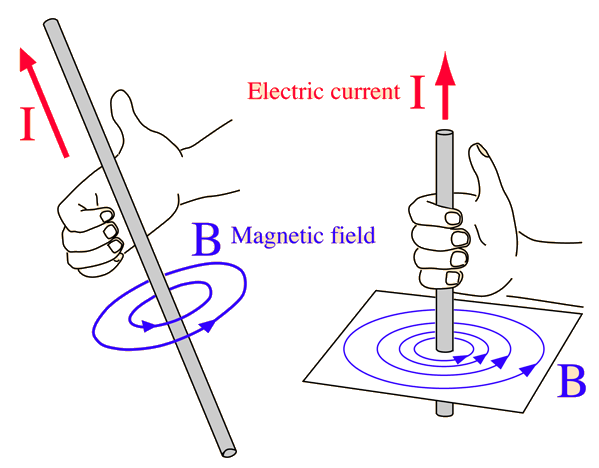
Straight wire
Basically little circles around the wire. Direction determined with right hand grip. (fig 1)
Figure 1
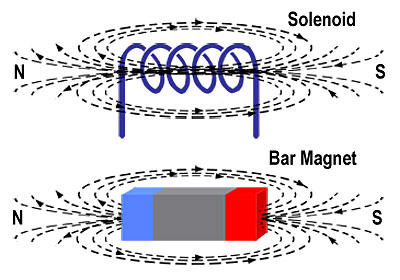
Solenoid (coil of wire)
Sort of like a regular magnetic field...in a tube... (fig 2) Direction can be found with right hand grip.
Figure 2

Flat coil
Like a regular wire x2 with a line in the middle. Again, determined with right hand grip. (fig 3)
Figure 3


6.9 Describe the construction of electromagnets

A coil of wire with a soft iron core and a current running through it will induce a magnetic field.

WARNING: do not use the word "create" for magnetic field, you will not get the mark :(

6.8 Understand that an electric current in a conductor produces a magnetic field round it

An electric current in a conductor, such as a wire, produces a magnetic field around it. Fairly self explanatory point. (: