Showing posts with label Motion. Show all posts

Wednesday, October 28, 2015

1.8 Determine the distance travelled from the area between a velocity-time graph and the time axis

Distance travelled = Area under the graph

Eg. in figure 1, you'd calculate the area of triangles A and C, as well as the area of rectangle B. So:
A = 0.5 x B x H
= 0.5 x 10 x 20
= 100m
B = B x H
= 20 x 20
= 400m
C = 0.5 x B x H
= 0.5 x 40 x 20
= 400m

Add everything ~400 + 400 + 100 = 900m
Figure 1


1.7 Determine acceleration from the gradient of a velocity-time graph

Acceleration = gradient of graph


Gradient = Rise ÷ Run
[Change in y (rise) ÷ change in x (run)]

In figure 1, the rise would be the dotted line and the run would be how far it is, i.e. from 2 to 6 on the graph below. Let's say that each dash on the y axis represents 1 (i.e. the scale goes 1, 2, 3, 4 etc)

So, if you were to calculate the acceleration:
G = rise ÷ run
= 4 ÷ 5
= 0.8 m/s^2
Figure 1

1.6 Plot and interpret velocity-time graphs

Figure 1: Distance time graph example
Plotting
  • Velocity on y axis
  • Time on x axis
Interpreting
  • Diagonal line going upwards = acceleration
  • Diagonal line going downwards = deceleration
  • Horizontal straight line = constant speed (but not necessarily terminal velocity)
  • The steeper the line, the more acceleration/deceleration


1.4 Describe experiments to investigate the motion of everyday objects such as toy cars or tennis balls

You could do the following experiment:

  • Take a toy wind-up car and put it next to a ruler that is a meter long
  • Wind up the toy car x amount of times
  • Every 5 seconds, record distance travelled by car
  • Plot a graph (distance time graph)

1.5 know and use the relationship between acceleration, velocity and time

Acceleration = (Final velocity - Initial velocity) ÷ time

Acc. = (v - u) ÷ time

Velocity - m/s
Time - seconds
Acceleration -  m/s2

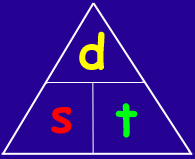
1.3 Know and use the relationship between average speed, distance moved and time

Average speed = Distance moved ÷ Time

S = D ÷ T

Velocity = Distance moved ÷ Time

V = D ÷ T

Velocity/speed - m/s
Distance - m
Time - seconds


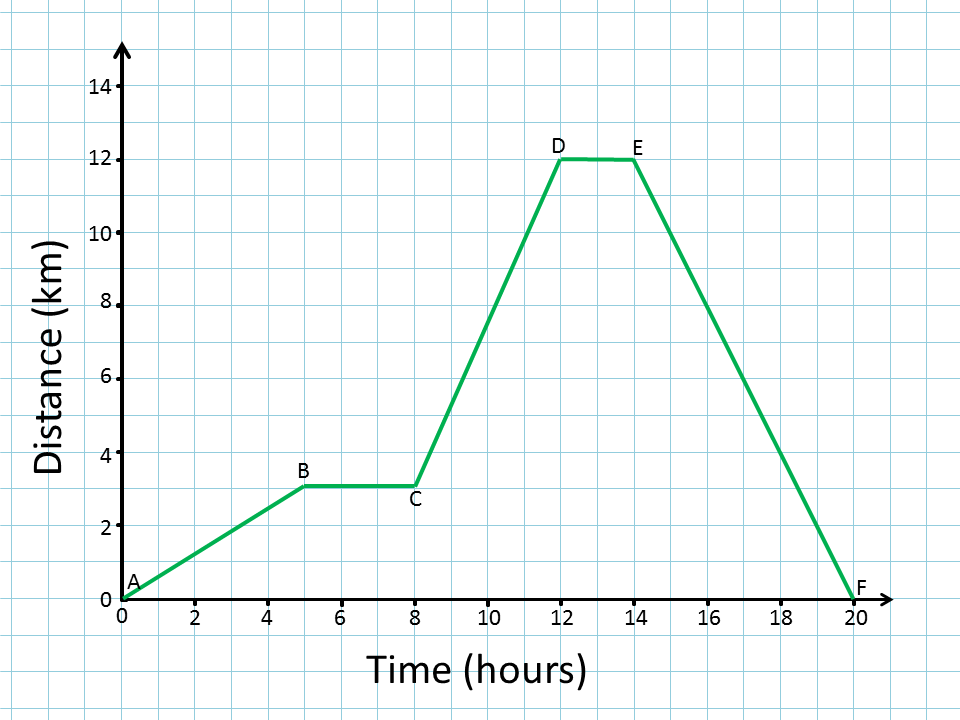
1.2 Plot and interpret distance-time graphs

Plotting
  • Distance must be on the y axis
  • Time must be on the x axis
Interpreting
  • Straight horizontal line (--) means the object is stationary
  • Diagonal line upwards ( / ) means the object is moving forwards. The steeper the line, the faster it is moving.
  • Diagonal line downwards ( \ ) means the object is moving backwards. Again, the steeper the line, the faster it is moving.
  • Although this will most likely not appear in GCSE questions, a curve upwards also means there is an acceleration, a downwards curve means a deceleration

1.1 Use the following units: kilogram (kg), metre (m), metre/second (m/s), metre/second2 (m/s2), newton (N), second (s), newton per kilogram (N/kg), kilogram metre/second (kg m/s)

Measurement                      Symbol               What it measures
Kilogram                                  Kg                           Mass
Meter                                        m                       Distance
Meter per second                    m/s                   Velocity/speed
Meter per second squared      m/s^2                 Acceleration
Newton                                         N                           Force
Kilogram meter per second     kg m/s                Momentum
Newton per kilogram               N/kg                     Moment

Saturday, October 24, 2015

1.21 Use the idea of momentum to explain safety features

We already know that force felt = change in momentum ÷ time

To decrease the force felt, you would have to increase the amount of time it takes for the force to be felt. In a car, there are various safety features equipped to do this, as they increase the time that the car's momentum takes to reach zero.

Eg crumple zones in cars slow down the time taken for the momentum to be transferred to the passenger

Some safety features include:
seat belts
air bags
crumple zones
All the above reduce injuries deforming and therefore increasing the amount of time it takes for a person to come to a stop, reducing the acceleration and force on the person, so reducing injury :)
Image: drawing of two safety features of the car. (by: me!!) 
(Yeah okay it's not amazing but it gets the message across)

1.20 Know and use the relationship between momentum, mass and velocity

Momentum = Mass x Velocity

P = M x V

P is measured in kg m/s
M is measured in kg
V is measured in m/s

1.19 Describe the factors affecting vehicle stopping distance including speed, mass, road condition and reaction time

Stopping distance = Breaking + Thinking distance

Things that could affect this include:

  • Mass of the vehicle ~ The more mass, the more momentum, meaning it is harder to stop.
  • Speed (velocity) of vehicle ~ The faster, the harder to stop
  • The state of the driver 
  • Weather conditions ~ Snow, ice and rain can make the road slippery
  • Condition of the tyres ~ If more worn, less grip so it will slip more easily
  • Condition of the brakes ~ If more worn, they have less of a grip on the inner wheel bit thingie (what's it called?) 
Condition of driver

Drugs, tiredness, alcohol etc. increase thinking distance while things such as caffeine can temporarily increase alertness.


1.18 Describe experiments to investigate the forces acting on falling objects, such as sycamore seeds or parachutes

Parachutes

If you drop a parachute from a height (height x) with a mass attached (mass y), it shows that gravity is acting on it. However, due to the parachute, it falls slower than if you dropped mass y from height x without the parachute. A possible experiment to investigate this would be to change the size (S.A.) of each parachute (let's say you have 5 of them) and attach mass y, dropping them from height x each time and measuring how long they take to reach the ground using a stopwatch. To make the experiment fair, you would have to keep the mass, height, material of the parachute, environment and the way it is dropped the same.


Sycamore seeds

Sycamore seeds work in a very similar way. If you were to do the experiment with sycamore seeds, you would have to get, let's say, 5 sizes of seeds, measuring their S.A. and labelling them (by S.A.). Then, you drop them from the top of a 1m ruler and record how long each one takes to reach the floor / table, using a stopwatch to time it. You'd have to keep the height, way the seeds are dropped, environment, etc the same. for the experiment to be fair.


Common pattern

If you plotted a graph for the experiments above, you would see that there is a direct correlation between the time it takes for the parachute / seed to reach the floor and the surface area: the bigger the surface area, the longer it takes for it to reach the floor.


Explanation

This is because increased surface area means that there's a greater space to experience air resistance, which opposes gravity / weight. This makes the fall slower if the surface area is greater. As it experiences more air resistance, it increases more quickly, so it balances out the weight (downwards force) faster too. This causes the object to reach terminal velocity faster. However, because of this, it reaches terminal velocity before it has a chance to accelerate very much (in comparison to an object with less surface area) and therefore falls slower.


KEY ♡
pink = independent variable
blue = dependent variable
red = controlled variables
S.A. = surface area

1.17 Describe the forces acting on falling objects and explain why falling objects reach a terminal velocity

When an object begins to fall, it accelerates (gains speed) because its weight (the downwards force) is greater than the drag (air resistance). 

As it accelerates, the drag also increases until the forces balance each other out. The resultant force then equals zero (because they're balanced) and in order for an object to accelerate, forces must be unbalanced, so due to this, the object can no longer accelerate. It reaches the maximum velocity that could possibly be achieved during free fall: terminal velocity.

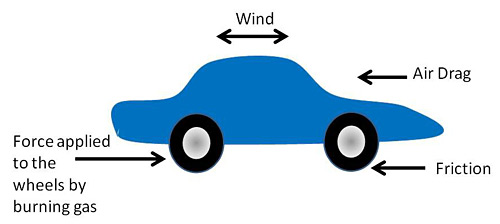
1.14 understand that friction is a force that opposes motion

Friction is a force that opposes motion. This means that if you have a moving object (let's say a car), friction will be a force that acts in the opposite direction of the movement.