Measurement Symbol What it measures
Kilogram Kg Mass
Meter m Distance
Meter per second m/s Velocity/speed
Meter per second squared m/s^2 Acceleration
Newton N Force
Kilogram meter per second kg m/s Momentum
Newton per kilogram N/kg Moment
Showing posts with label Moments. Show all posts
Showing posts with label Moments. Show all posts
Wednesday, October 28, 2015

Saturday, October 24, 2015
1.28 Understand that the upward forces on a light beam, supported at its ends, vary with the position of a heavy object placed on the beam
The upwards forces on a beam, supported at both ends, varies with the position of the object on it. (Yes, I am fully aware that I just re-worded the specification point.)
Basically, if you have a plank/bridge/thing supported by 'pivots' at both ends and you then place a mass on the plank, the pivots would have to exert a greater force to equal the downward force produced by the mass

Basically, if you have a plank/bridge/thing supported by 'pivots' at both ends and you then place a mass on the plank, the pivots would have to exert a greater force to equal the downward force produced by the mass

I drew this diagram to help explain the point. If the tree was closer to pivot A, it would exert a greater downwards force on it, so it [pivot A] would have to exert a greater upwards force to balance this.
1.27 Know and use the principle of moments for a simple system of parallel forces acting in one plane
For this, you need to know how to manipulate the equation (Moment = F x D). If the straight line is balanced, the moment on both sides: clockwise and anticlockwise, will be the same.
Eg A
mass 1 . mass 2
/\
If mass 1 weighs 50 N and is 10m from the pivot and mass 2 weighs 200N and is 5m from the pivot, what is the moment caused by mass 1 and mass 2?
Moment 1 = F x D
= 50 x 10
= 500 NM (Moments measured in newton meters; NM)
Moment 2 = F x D
= 200 x 5
= 1000 NM
Eg B
mass A . mass B mass C
/\
If mass A weighs 100N and is 5m from the pivot, mass B is 2m from the pivot and weighs 50 N and mass C is 8m from the pivot and weighs 50N, what is the moment on the left side and the right side?
Moment L = F x D
= 100 x 5
= 500 NM
Moment R1 = F x D
= 50 x 2
= 100 NM
Moment R2 = F x D
= 50 x 8
= 400 NM
Moment R1 + R2 = 500 NM
In example B, the moment on the left side and the right side is equal.
Eg A
mass 1 . mass 2
/\
If mass 1 weighs 50 N and is 10m from the pivot and mass 2 weighs 200N and is 5m from the pivot, what is the moment caused by mass 1 and mass 2?
Moment 1 = F x D
= 50 x 10
= 500 NM (Moments measured in newton meters; NM)
Moment 2 = F x D
= 200 x 5
= 1000 NM
Eg B
mass A . mass B mass C
/\
If mass A weighs 100N and is 5m from the pivot, mass B is 2m from the pivot and weighs 50 N and mass C is 8m from the pivot and weighs 50N, what is the moment on the left side and the right side?
Moment L = F x D
= 100 x 5
= 500 NM
Moment R1 = F x D
= 50 x 2
= 100 NM
Moment R2 = F x D
= 50 x 8
= 400 NM
Moment R1 + R2 = 500 NM
In example B, the moment on the left side and the right side is equal.
1.25 know and use the relationship between the moment of a force and its distance from the pivot
Moment = Force x Perpendicular distance from pivot

(Moment = Force x Distance)
Moment = F x D
Force is measured in N
Distance is measured in M
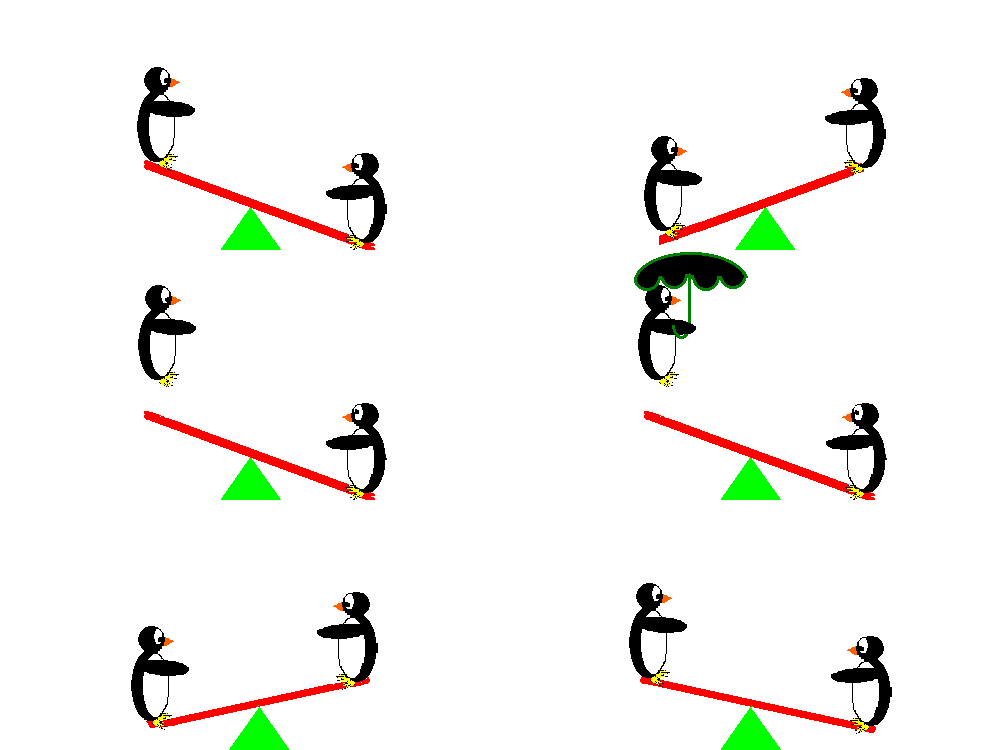
Eg in this image, the pivot is the top point of the green triangle.
1.22 Use the conservation of momentum to calculate the mass, velocity or momentum of objects.
Conservation of momentum means that momentum is conserved if it is not disrupted by external forces.
momentum at the start = momentum at the end
For this, you would use the equation:
Momentum = Mass x Velocity
P = M x V
(momentum measured in kg m/s, mass in kg and velocity in m/s)
momentum at the start = momentum at the end
For this, you would use the equation:
Momentum = Mass x Velocity
P = M x V
(momentum measured in kg m/s, mass in kg and velocity in m/s)
Eg: Two cars are on the same road, moving in the same direction. Car 1 has a mass of 2000kg and Car 2 has a mass of 1000kg, moving at 20 m/s. Car 1 is stationary.
a) How much momentum does each car have (at the start?)
b) What is the momentum at the start?
c) What is the momentum of each car after the crash?

a) How much momentum does each car have (at the start?)
b) What is the momentum at the start?
c) What is the momentum of each car after the crash?
a ) Car 1
P = M x V
= 2000 x 0
= 0 kg m/s
Car 2
P = M x V
= 1000 x 20
= 20,000 kg m/s
b) The momentum at the start would be the momentum of Car 2; 20,000 kg m/s
c) Momentum at the start = momentum at the end
Car 1 now was hit with 20,000 kg m/s of momentum while car 2's momentum dropped to ZERO.
Subscribe to:
Posts (Atom)