Gravitational potential energy is often transferred to kinetic energy (i.e. in a pendulum) and work done is equal to energy transferred :)
An object gains GPE when it is above the ground. The higher up it is, the more GPE it has. An object has kinetic energy when it is moving.
Showing posts with label Transfer of energy. Show all posts
Showing posts with label Transfer of energy. Show all posts
Thursday, November 5, 2015

Saturday, October 31, 2015
4.16 Describe the energy transfers involved in generating electricity using several different methods
Solar (panels)
Light energy from the sun (Don't say solar energy!! There is no such thing as solar energy!) is transferred by the solar cells into electrical energy (though in some water heating systems, the solar energy is used to heat water, which means light to thermal energy)
Hydro
Kinetic energy of the water spins a turbine, which is connected to a generator. This generator transfers the kinetic energy into electrical energy
Wind
Kinetic energy from the wind turns the blades, which are connected to a turbine. The turbine spins, which is connected to a generator. This generator takes the kinetic energy and transfers it into electrical energy :)
Geothermal
The thermal energy from the ground is used to heat water, which turns to steam and is pressed through narrow pipes: the thermal energy has been converted to kinetic energy, which is used to spin a turbine, which spins a generator which turns this kinetic energy into electrical energy.
Nuclear
Nuclear energy is transferred to heat energy as it is used to heat up the water. This heat is then transferred to kinetic energy, which spins a turbine connected to a generator. The generator transfers the kinetic energy from the turbine into electrical energy.
Fossil fuels
(coal, oil, natural gas, etc.)
The chemical energy in the fossil fuel (i.e. coal) is transferred into heat energy as it causes the water to evaporate as it is heated. The steam travels through narrow tubes - the heat energy was transferred to kinetic energy. This steam makes the turbine spin, which is connected to a generator and its (kinetic) energy transferred to electrical energy.
 |
| Figure 1: Parts of a nuclear power station |
Friday, October 30, 2015
4.17 Describe the advantages and disadvantages of methods of large scale electricity production from various renewable and nonrenewable resources.

Figure 1: A table that I made. Note that "P.S." stands for power station :)
If you have access, make the right choice. Opt for a renewable source of energy. Try using biofuel instead of natural gas and heat your water with a solar panel ^_^ The earth says thank you.
This is a really good website if you want some more in-depth stuff (click below)
Sunday, October 25, 2015
4.8 Explain how insulation is used to reduce energy transfers from buildings and the human body.
Objects/materials that are insulators are bad conductors. They often "keep" the heat, reflect it, etc and are usually non metals. Examples of insulators include:
In humans, heat loss occurs mainly from the torso, as can be seen in Figure 4.
To reduce heat loss in the human body, you could do the following:
- Bubble wrap
- Lids
- Foam
- Duvet covers
- Wool
If an object is surrounded by an insulator, it will lose less heat by conduction. If there is little or no space for particle movement in a liquid or gas, less heat will be lost through convection. Shiny materials can be used to reflect radiation, while black, matt surfaces will absorb the most heat (but, because the hotter the object the more infrared it radiates, will also radiate the most heat)
In cold environments, you'd want to keep your body or your house nice and warm :) and lose as little heat as possible.
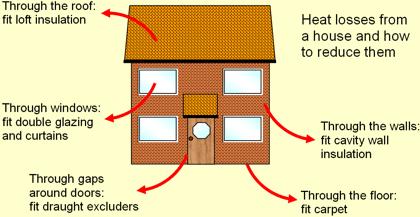
In buildings (let's say a house, as an example), much of the heat is lost through the roof and un-insulated walls.
 |
| Figure 1: Heat loss in a house |
How insulation can help:
 |
| Figure 2 |
- Heat loss through the roof: fit loft insulation. An insulating material is used to reduce heat loss through conduction and convection, as there is no space for air to circulate and therefore no convection currents can be created within this gap. It works similarly to cavity wall insulation.
- Heat loss through walls: fit cavity wall insulation. Insulating material is blown through the gap between the bricks and the wall, stopping heat loss through conduction and convection as, again, there is no space for air to circulate.
- Heat loss through windows: double or triple glaze. This helps reduce heat loss through conduction as air (between layers of glass) is a poor conductor and convection is unlikely to occur because the gap is very small. Curtains also help reduce heat loss.
- Heat loss through doors: cover the gap between the floor and the door with a draught excluder (see figure 3). This stops heat from escaping through convection and conduction. If the door has glass or a window, see heat loss through windows.
- Heat loss through floor(s): lay down carpets. This stops heat loss through conduction as cloth used for carpets is a very poor conductor.
 |
| Figure 3: Draught excluder example |
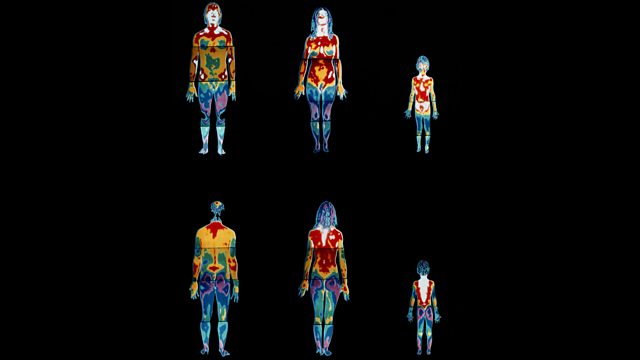 |
| (Source: BBC Bitesize) Figure 4: A thermogram of a man, woman and child |
- Use insulating clothing (eg socks, scarves, hats) because warm air is often trapped in materials such as wool.
- Wear insulating jackets - some jackets are a bit puffy, meaning they have air pockets that stop heat loss through conduction
The more layers you wear, the warmer you'll be!
4.7 Explain the role of convection in everyday phenomena
Convection is when hot particles in liquids and gases rise and cool particles sink. Some examples of this include:
- Heating in houses: the convection current created by a heater (or various heaters) in a room
- Convection currents in the mantle: causes tectonic plates to move, creating earthquakes, mountains and volcanoes :)
- Your coffee/hot chocolate: Convection happens as the hot liquid heats the air creating a convection current which cools down your drink. Lids can help avoid this.
 |
| Figure 1: Location of mantle |
 |
| Figure 2: A hot cup of....coffee? |
4.6 Describe how energy transfer may take place by conduction, convection and radiation
Conduction
This is when energy is transferred when one object touches another. It happens most commonly in metals with electrical and heat energy being transferred through them.When heat is added to a good conductor, the particles begin to vibrate where the heat is directly applied. They begin to vibrate faster and faster, bumping into other particles, which then begin to vibrate too. With this, the vibrations are passed throughout the entire material. Metals are (mostly) very good heat and electrical conductors. Non metals and gases are usually poor conductors. Very poor conductors (like wood, plastic, etc) are called insulators.

Source: BBC Bitesize
Figure 2
Convection
Convection happens in liquids and gases, as their particles can move around. When heat is applied to an area, the particles gain energy (thermal → kinetic) and move faster. Because of this, they often move further apart and the substance becomes slightly less dense, causing the heated particles to rise above the rest (which are colder, in comparison). When these particles rise to a certain point, they become cool again and the process happens in reverse: as they lose energy, they move closer to each other and become denser again as they sink. The cycle repeats and a convection current is created.

(sorry the GIF isn't amazing) Source: BBC Bitesize
Figure 2
Radiation
This is when heat is transferred through infrared waves. The hotter the object, the more infrared it emits (which all objects emit). This does not need matter to occur. It is a type of electromagnetic radiation and can happen even in vacuum, unlike convection and conduction.
Infrared ray ↴
Hot Cold
 Cold
Heat always travels from hot to cold
 |
| Figure 4 |
4.5 Describe a variety of everyday and scientific devices and situations, explaining the fate of the input energy in terms of the above relationship, including their representation by Sankey diagrams
Everything uses energy. However, energy is often wasted, most commonly as heat. The more useful energy an object/organism outputs, the more efficient it is.
For example, a television [TV] is meant to transfer (not produce!!) electrical energy to light and sound energy. However, (especially in older models) some of this energy is wasted as heat.

This information can be represented as a Sankey diagram (figure 1). To draw a sankey diagram, you must make sure the arrows are proportional: if the useful output is 100J and the wasted energy is 50 J, the wasted energy arrow should be about half as big as the useful output arrow.
The left part (where in Figure one is says 250 J) is always the energy input.
The right part is where useful energy comes "out" of.
The bottom (where it says 50J) is wasted energy. Note that wasted energy is not lost, it is transferred to other forms that are not useful.
For example, a television [TV] is meant to transfer (not produce!!) electrical energy to light and sound energy. However, (especially in older models) some of this energy is wasted as heat.

Figure 1 ↑
The left part (where in Figure one is says 250 J) is always the energy input.
The right part is where useful energy comes "out" of.
The bottom (where it says 50J) is wasted energy. Note that wasted energy is not lost, it is transferred to other forms that are not useful.
Saturday, October 24, 2015
4.2 Describe energy transfers involving the following forms of energy: thermal (heat), light, electrical, sound, kinetic, chemical, nuclear and potential (elastic and gravitational)
There are 9 types of energy (stated in the specification point). Energy is transferred all the time, all around us. Some examples of energy transfers include:

- Chemical to thermal energy (fireplace kind of fire - the wood provides chemical E.)
- Gravitational potential to kinetic energy (pendulum)
- Electrical to light and sound energy (TV)
- Nuclear to electrical energy (power station)
- Elastic to kinetic energy (bow and arrow)

An example of how energy can be transferred
Subscribe to:
Posts (Atom)