Frequency = 1 / period
Period = 1 / frequency
Frequency in Hz (hertz)
Period in s (seconds)
Showing posts with label Equations. Show all posts
Showing posts with label Equations. Show all posts
Saturday, September 17, 2016

3.5 Know and use the relationship between the speed, frequency and wavelength of a wave:
Speed = frequency x wavelength
V = f x λ
Speed in m/s
Frequency in Hz
Wavelength in m
V = f x λ
Speed in m/s
Frequency in Hz
Wavelength in m
Tuesday, May 31, 2016
6.20 Know and use the relationship: input power = output power for 100% efficiency
VPIP =VSIS
Voltage primary x current primary = voltage secondary x current secondary
Voltage in volts (v)
Current in amps (A)
Voltage primary x current primary = voltage secondary x current secondary
Voltage in volts (v)
Current in amps (A)
6.19 Know and use the relationship between input (primary) and output (secondary) voltages and the turns ratio for a transformer:
Vp/Vs = Np/Ns
Voltage primary ÷ voltage secondary = Number of coils in primary ÷ number of coils in secondary
Number of coils has no units
Voltage is in volts
Voltage primary ÷ voltage secondary = Number of coils in primary ÷ number of coils in secondary
Number of coils has no units
Voltage is in volts
Saturday, May 28, 2016
1.35 Use the relationship between orbital speed, orbital radius and time period
- orbital speed = 2 x π x r / T
- ( 2 x pi x radius ÷ time)
Orbital speed in m/s
Radius in m
Time in sec
Thursday, February 4, 2016
2.16 Know and use the relationship between charge, current and time:
Charge = Current x Time
Q = I x T
Q measured in coulombs (C)
I measured in amperes (A )
T is measured in seconds (sec)
Q = I x T
Q measured in coulombs (C)
I measured in amperes (A )
T is measured in seconds (sec)
2.14 Know and use the relationship between voltage, current and resistance:
IMPORTANT EQUATION!!
Voltage = Current x Resistance
V = I x R
Voltage measured in volts (V)
Current measured in amps (A)
Resistance measured in ohms (Ω)
You will need to re-arrange this equation a lot so keep this in mind:
Voltage = Current x Resistance
V = I x R
Voltage measured in volts (V)
Current measured in amps (A)
Resistance measured in ohms (Ω)
You will need to re-arrange this equation a lot so keep this in mind:
 |
| Figure 1 |
2.6 Use the relationship between energy transferred, current, voltage and time
E = I x T x V
(way to remember it is E = ITV)
Energy transferred = Current x Voltage x Time
Energy is measured in Joules (J)
Current is measured in amperes (A)
Voltage is measured in volts (V)
Time is measured in seconds (sec)
Converting...
1 A = 0.001 kilo amps (divide by 1000)
1A = 0.000001 mega amps (divide by 1 million; 1000000)
1A = 1000 miliamps
(If you understand, don't look at the one below because it might confuzzle you)
In other words...
1 KILO amp = 1000 amps
1 MEGA amp = 1000000 amps (that's a million)
I MILI amp = 0.001
Same applies to all else :)
(way to remember it is E = ITV)
Energy transferred = Current x Voltage x Time
Energy is measured in Joules (J)
Current is measured in amperes (A)
Voltage is measured in volts (V)
Time is measured in seconds (sec)
Converting...
1 A = 0.001 kilo amps (divide by 1000)
1A = 0.000001 mega amps (divide by 1 million; 1000000)
1A = 1000 miliamps
(If you understand, don't look at the one below because it might confuzzle you)
In other words...
1 KILO amp = 1000 amps
1 MEGA amp = 1000000 amps (that's a million)
I MILI amp = 0.001
Same applies to all else :)
2.5 Know and use the relationship: power = current × voltage and apply the relationship to the selection of appropriate fuses
Fairly self explanatory.
Power = Current x Voltage
P = I x V
P measured in watts (W)
I measured in amperes (A)
V measured in volts (V)
!!WARNING!!
I represents current. Although A is the symbol for the units, it does not represent current in an equation. If you write P = A x V in an exam you will get marked down because it is wrong.
Power is the rate of energy transferred. Fuses will usually tell you the voltage and current of the device, and from this, the power can be worked out
Power = Current x Voltage
P = I x V
P measured in watts (W)
I measured in amperes (A)
V measured in volts (V)
!!WARNING!!
I represents current. Although A is the symbol for the units, it does not represent current in an equation. If you write P = A x V in an exam you will get marked down because it is wrong.
Power is the rate of energy transferred. Fuses will usually tell you the voltage and current of the device, and from this, the power can be worked out
Saturday, October 31, 2015
4.12 Know and use the relationship between kinetic energy, mass and speed
Kinetic Energy = 1/2 x Mass x Velocity2
KE = 1/2 x M x V2
Kinetic Energy - J
Mass - kg
Velocity - m/s
KE = 1/2 x M x V2
Kinetic Energy - J
Mass - kg
Velocity - m/s
4.11 Know and use the relationship: gravitational potential energy = mass × g × height
Gravitational Potential Energy = Mass x Gravity x Height
GPE = M x G x H
Mass - kg
Gravity - 10 on earth (N/kg)
Height - m
GPE - J
GPE = M x G x H
Mass - kg
Gravity - 10 on earth (N/kg)
Height - m
GPE - J
4. 10 Understand that work done is equal to energy transferred
Work done = Energy Transferred
I.e. if the work done is 200J, and the question asks you, "what is the energy transferred?", the answer is 200J.
I.e. if the work done is 200J, and the question asks you, "what is the energy transferred?", the answer is 200J.
4.9 Know and use the relationship between work, force and distance moved in the direction of the force
Work done = Force x Distance
Force must be parallel to distance (otherwise you'll be working out the moment, and since there's no pivot, it would be wrong!)
W = F x D
Work done - J
Force - N
Distance - m
Force must be parallel to distance (otherwise you'll be working out the moment, and since there's no pivot, it would be wrong!)
W = F x D
Work done - J
Force - N
Distance - m
Friday, October 30, 2015
1.16 Know and use the relationship between weight, mass and gravity
Weight = Mass x Gravity
W = M x G
Weight is a force, so it's measured in newtons.
Mass ~ Kg
Gravity ~ 10 on Earth (units are mostly irrelevant, but if you really want to know, it's N/kg)
Fun fact, by Annabel:
The reason the unit for gravity is N/kg is because if you rearrange this equation so that gravity is the subject is becomes:
gravity = weight ÷ mass
which, in terms of units is gravity = N/kg
YOUR WEIGHT IS NOT THE SAME AS YOUR MASS!
Your mass never changes - if your mass is 50 kg, you will still have a mass of 50 kg on the moon, on mars, anywhere. Your weight does change, because it is the effect of gravity on your body - this changes from planet to planet. And in space, of course, your weight = almost 0W = M x G
Weight is a force, so it's measured in newtons.
Mass ~ Kg
Gravity ~ 10 on Earth (units are mostly irrelevant, but if you really want to know, it's N/kg)
Fun fact, by Annabel:
The reason the unit for gravity is N/kg is because if you rearrange this equation so that gravity is the subject is becomes:
gravity = weight ÷ mass
which, in terms of units is gravity = N/kg
Thursday, October 29, 2015
1.15 Know and use the relationship between unbalanced force, mass and acceleration:
Force = mass x acceleration
F = M x A
Mass - Kg
Force - N
Acceleration - m/s2
F = M x A
Mass - Kg
Force - N
Acceleration - m/s2
Wednesday, October 28, 2015
1.8 Determine the distance travelled from the area between a velocity-time graph and the time axis
Distance travelled = Area under the graph
Eg. in figure 1, you'd calculate the area of triangles A and C, as well as the area of rectangle B. So:
A = 0.5 x B x H
= 0.5 x 10 x 20
= 100m
B = B x H
= 20 x 20
= 400m
C = 0.5 x B x H
= 0.5 x 40 x 20
= 400m
Add everything ~400 + 400 + 100 = 900m
Eg. in figure 1, you'd calculate the area of triangles A and C, as well as the area of rectangle B. So:
A = 0.5 x B x H
= 0.5 x 10 x 20
= 100m
B = B x H
= 20 x 20
= 400m
C = 0.5 x B x H
= 0.5 x 40 x 20
= 400m
Add everything ~400 + 400 + 100 = 900m
 |
| Figure 1 |
1.7 Determine acceleration from the gradient of a velocity-time graph
Acceleration = gradient of graph
Gradient = Rise ÷ Run
[Change in y (rise) ÷ change in x (run)]
In figure 1, the rise would be the dotted line and the run would be how far it is, i.e. from 2 to 6 on the graph below. Let's say that each dash on the y axis represents 1 (i.e. the scale goes 1, 2, 3, 4 etc)
So, if you were to calculate the acceleration:
G = rise ÷ run
= 4 ÷ 5
= 0.8 m/s^2
Gradient = Rise ÷ Run
[Change in y (rise) ÷ change in x (run)]
In figure 1, the rise would be the dotted line and the run would be how far it is, i.e. from 2 to 6 on the graph below. Let's say that each dash on the y axis represents 1 (i.e. the scale goes 1, 2, 3, 4 etc)
So, if you were to calculate the acceleration:
G = rise ÷ run
= 4 ÷ 5
= 0.8 m/s^2
 |
| Figure 1 |
1.5 know and use the relationship between acceleration, velocity and time
Acceleration = (Final velocity - Initial velocity) ÷ time
Acc. = (v - u) ÷ time
Velocity - m/s
Time - seconds
Acceleration - m/s2
Acc. = (v - u) ÷ time
Velocity - m/s
Time - seconds
Acceleration - m/s2
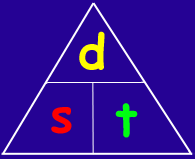
1.3 Know and use the relationship between average speed, distance moved and time
Average speed = Distance moved ÷ Time
S = D ÷ T
Velocity = Distance moved ÷ Time
V = D ÷ T
Velocity/speed - m/s
Distance - m
Time - seconds

S = D ÷ T
Velocity = Distance moved ÷ Time
V = D ÷ T
Velocity/speed - m/s
Distance - m
Time - seconds
Saturday, October 24, 2015
4.4 Know and use the relationship between useful energy output, total energy input and efficiency
Efficiency = useful energy out ÷ total energy in (x 100)
Efficiency - %
Energy - J (joules)
Eg: If you have a lightbulb and it is "fed" 100J of energy, of which 10J are transferred into light energy and the rest is wasted as heat energy, what is the efficiency of the bulb?
 Eff = E. useful out ÷ E. in
= 10 ÷ 100
= 0.1 x 100
= 10% efficient
Conclusion: The poor person that bought this light bulb is going to have a very hot house/office/building and is going to have an enormous electricity bill. Also, it's a waste of money. And bad for the environment.
(don't write that [this "conclusion"] in your exam - the examiner probably won't find it funny.)
Efficiency - %
Energy - J (joules)
Eg: If you have a lightbulb and it is "fed" 100J of energy, of which 10J are transferred into light energy and the rest is wasted as heat energy, what is the efficiency of the bulb?

= 10 ÷ 100
= 0.1 x 100
= 10% efficient
Conclusion: The poor person that bought this light bulb is going to have a very hot house/office/building and is going to have an enormous electricity bill. Also, it's a waste of money. And bad for the environment.
(don't write that [this "conclusion"] in your exam - the examiner probably won't find it funny.)
Subscribe to:
Posts (Atom)